

Knowing your growing zone is one of the keys to good gardening. This article helps you find the right plants for your area.
Plant Hardiness Zones
Plant hardiness zones are areas that have been labeled by their average minimum growing temperature. These zones help gardeners figure which plants will thrive in their growing environment.
As shown in the USDA map below, the hardiness zones defined by the USDA begin with zone 1, which is the coldest and end with zone 13, which encompasses the warmest growing areas.
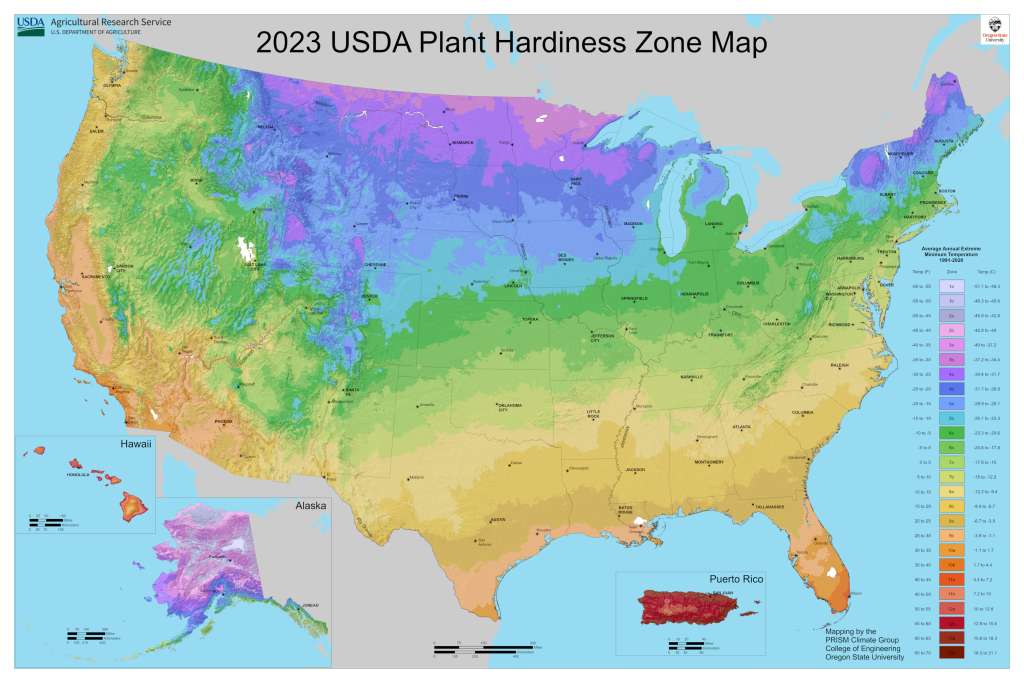
- Zone 1 (-60°F to -50°F)
- Zone 2 (-50°F to -40°F)
- Zone 3 (-40°F to -30°F)
- Zone 4 (-30°F to -20°F)
- Zone 5 (-20°F to -10°F)
- Zone 6 (-10°F to 0°F)
- Zone 7 (0°F to 10°F)
- Zone 8 (10°F to 20°F)
- Zone 9 (20°F to 30°F)
- Zone 10 (30°F to 40°F)
- Zone 11 (40°F to 50°F)
- Zone 12 (50°F to 60°F)
- Zone 13 (60°F to 70°F)
Plant Hardiness Subzones
Each hardiness zone differs by 10 degrees Fahrenheit and is often split into two subzones, labeled “a” and “b,” which differ by 5 degrees Fahrenheit.
For example, zone 6’s range is between -10 and 0 degrees Fahrenheit. In Zone 6a, average freezing temperatures hit between -10 to -5 degrees Fahrenheit; 6b’s range is between -5 and 0 degrees Fahrenheit.
Understanding your subzone will definitely help you make more precise decisions about your garden. To identify your subzone, find your overarching zone on the USDA’s map — and then do a narrow location search with your zip code to find out whether you’re “a” or “b.”
Gardening by Region
The USDA also divides gardening zones by region across the United States. These regions include North Central, Northeast, Northwest, South Central, Southeast, and Southwest.
To better understand every region, look to these descriptions, which include the states in each region, the zones that run through them, and their typical climate conditions.
North Central
The climate is quite cool across this region of the US.
- Zones: 2-5
- States: North Dakota, South Dakota, Minnesota, Wisconsin, Nebraska, Iowa, Illinois, Kansas, and Missouri
Northeast
Temperatures vary greatly across the Northeast and encompass a wide range of zones.
- Zones: 1-7
- States: Michigan, Indiana, Ohio, Kentucky, Virginia, West Virginia, Pennsylvania, New York, New Jersey, Maryland, Delaware, Connecticut, Massachusetts, New Hampshire, Maine, Vermont, and Rhode Island
Northwest
Conditions in the Northwest are generally wet in the winter and dry during the summer.
- Zones: 3-9
- States: Washington, Oregon, Montana, Idaho, Wyoming, and Northern California
South Central
This region is generally defined as the area from the southern Great Plains to the Gulf of Mexico.
- Zones: 6-9
- States: Parts of Texas, Oklahoma, Arkansas, Louisiana, Mississippi, and Alabama
Southeast
The last frost date in this region typically occurs in April, but note that southern Florida does not experience a frost at all.
- Zones: 7-10
- States: Tennessee, North Carolina, South Carolina, Mississippi, Alabama, Georgia, and Florida
Southwest
The region known for its extreme heat especially in the summer
- Zones: 3-10
- States: California, Nevada, Utah, Colorado, Arizona, and New Mexico.
Gardening by Zone
Find your zone below to see which plants grow best where you live. Plus, get expert tips, tricks, and advice tailored to your specific growing zone no matter where you live.


Suggested Reads:
- USDA Zone Explanation: What Do Hardiness Zones Mean
- USDA Planting Zones: What Is My Growing Zone?
- Heat Zone Map Info: What Do Heat Zones Mean
Top Questions
Knowing your gardening zone is not complicated. Learn how to find your zone on handy USDA maps and plan your garden accordingly.
The United States Department of Agriculture (USDA) has a map that defines 13 planting zones.
This will depend a lot on your goals and what plants you want to grow in your garden. For example, if you’re looking to start a food forest, zones 7, 8, and 9 are considered the most versatile US hardiness zones. They’re both the southern and northern range of a lot of stuff, so that would be a good bet. Also consider microclimate, which could give you a wider range still.
If you’re looking to find your growing zone, check out the USDA planting zones map, find which zone you garden in. You can use the map by simply looking at it and finding your location, or you can use the USDA’s zip code tool.
Sign up to get our FREE weekly emails
Gardening guides, tips, & videos delivered right to your inbox!


