Knowing your growing zone in California will help you select the right plants for your area, thus having a successful gardening journey.
California Planting Zones
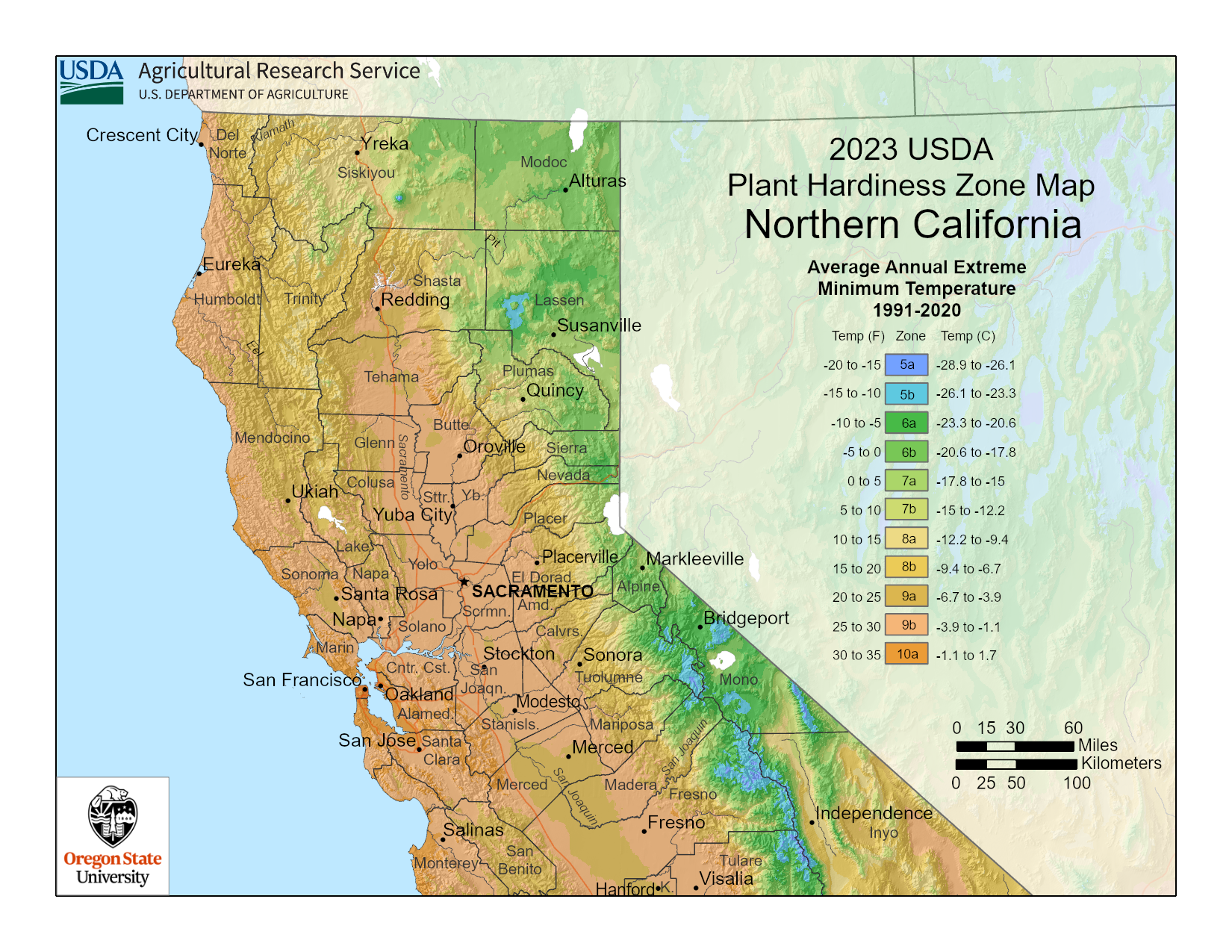
Because of the State’s large land size, California growing zone maps cover a wide range of temperatures and are divided into two sections.

Click here for full resolution USDA California growing zones map
To figure the planting zone for California that you live in, simply find the area on the maps above and match the color of that area to the map legend to the right or left.
Mountainous regions are classified as zones 5 and 6 due to their harsher climate. The moderate, Mediterranean climate that is predominant along the coast is associated with Zones 9, 10, and 11.
This variation enables California gardeners to cultivate an extensive variety of plants that are well-adapted to the region’s climate.
The above California planting zones map, which is based on the 2023 USDA plant hardiness map, can help you with your selection of zone-appropriate plants for your garden. Having the right plants for your area will ensure that they will thrive and survive from one year to the next.
Reputable nurseries will clearly mark what zone a plant is appropriate for. You will need to opt for plants that will grow in your zone or less. For example, if you live in zone 7, you can grow any plant that lives in growing zones 8-1. Any plant that belongs to a planting zone with a larger number than the one you live in will need protection from the cold in the winter.
Top Questions
Because the state is very large, it is actually further divided into two growing zones, the Northern and Southern planting zones. The northern half of California planting zone can be anywhere from 5a to 10b. The southern region of the State has zones 5a to 10a.
In accordance with latitude, elevation, and proximity to the Pacific Coast, California’s climate ranges from hot desert to alpine tundra. With warmer, drier summers and chilly, wetter winters, the Sierra Nevada foothills, the coastal regions of California, and a large portion of the Central Valley all have a Mediterranean climate. Coastal regions experience warmer winters and significantly cooler summers as a result of the ocean’s moderating effect on temperature extremes.
The southern region of California has planting zones 5a to 10a.
You can use the USDA map to find which California planting zone you garden in. The latest edition of the growing zone map has so many useful details, making it easier to pinpoint your exact zone. You can use the map by simply looking at it and identifying your location, or you can use the USDA’s zip code tool.
Sign up to get our FREE weekly emails
Gardening guides, tips, & videos delivered right to your inbox!